
Introduction: Power for Women
In Salem, during the trials, accusations of witchcraft were often used to discredit someone and seize their land, as practitioners of magic were not allowed to have property. An old widow might be called a witch so the estate she inherited from her late husband could be plundered and she forced to confess to keep her life. Women in this time period were given a rare moment of power, which in this paper will be defined as the ability to influence oneself and others. Seen in Arthur Miller’s The Crucible, an accused woman is given great credibility when naming others as her conspirators. She, for once, controls the fate of those around her. The cost of her power is the downfall of those she accuses.
A similar relation can be drawn with stepmothers commonly found in fairytales; it seems that the stepmother gains power only through the original mother’s departure (often death), and perhaps the defeat of her stepchildren (often to get husband’s attention or inheritance). However, as we take a look at events from the opposite point of view, a lot of sociological and gendered conceptions will begin to appear, the first of which is the idea of controlling images which “function as racialized and gendered stereotypes that justify the oppression of certain groups and naturalize existing power relations, while forcing oppressed populations to police their own behavior”. (Dow, 164) It’s certainly easier to apply controlling images to the Salem example: the image of the witch was constructed and forced upon several woman of the time so they could be justifiably killed, exiled, stolen from, and more. No one is stealing land from a cartoon in a movie, but the image of the wicked stepmother is used to allow characters to act upon other characters by fighting, insulting, degrading, pranking, even letting die; all because they have been named an enemy. The controlling image allowed us to hate them and hope for their demise.

This paper seeks to point out that these patterns in behavior shown in fairytales have roots in real-world sexism, and affect the reality outside of the story now.
The Creation and Reception of the Stepmother: Why and How
Often for protagonists to succeed they must have an opposite to defeat; a beautiful young girl must beat her older serious stepmother. It’s remarkable because the biological mothers are rarely presented as anything less than saints in rose-colored memories. Bettelheim, a psychologist who delved into this subject, would suggest that the existence of the ‘real’ mother in opposition to the stepmother serves to separate all good and bad qualities into singular beings that contain them completely. The idea is to show children which is more favorable; in disparaging stepmothers, ‘real’ mothers are made perfect.
This concept may apply rather well to simple morals: the antagonist may steal or cheat to reach their goals and ultimately fail, while the protagonist will get what they want by using desirable actions, such as teamwork and honesty. This teaches the children watching that if they are to get what they want and receive positive attention, they should mimic the heroes in the stories, and avoid the behaviors the villains display. This ties in closely to socialization theories of child development. We can see three of these theories at work. First, Social Learning Theory, which is defined, basically, through rewards and punishments that help direct behavior. The characters in a fairytale are rewarded and punished depending on whether they embody ‘good’ or ‘bad’ respectively. However, children who witness a fairytale are not being directly rewarded or punished. So we move on to Cognitive Developmental Theory, where children have the autonomy to seek out information and draw conclusions; they’ll be able to relate what they see and hear in a story to what they experience in their lives. But this theory might give kids too much credit, and fails to take into account context.
So of course, the most accurate theory is the most complex: Symbolic Interaction Theory, which is divided in three parts. First, we have the ‘looking-glass self’, where we see ourselves as others see us. Next, there’s the ‘I’ and the ‘Me’, that dictates that an individual will anticipate behavior from external sources and adapt their own self as they go along (i.e. identity of self differs to the fluctuating shown identity). Finally, there’s the ‘generalized other’ where we act the way we believe we are expected to act. All three may seem similar, and they build upon the same idea, but their differences help apply them to specific situations. They all work off what is missing in Cognitive Developmental Theory: the effect of others’ upon an individual. This is where the topic of this paper becomes so relevant; what may seem like a harmless story is feeding information to children and helping build assumptions of what is expected of them.
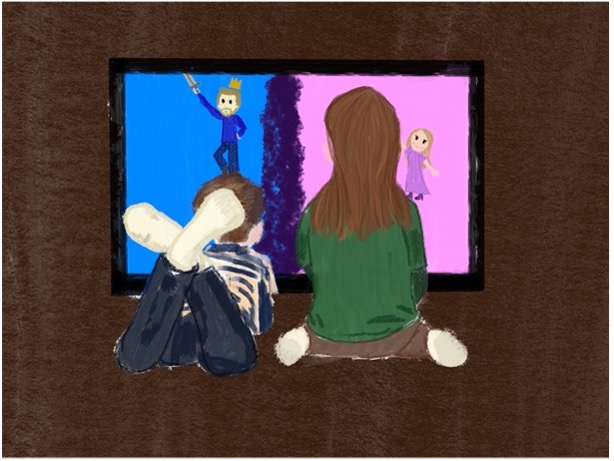
The danger in this use of polar opposite characters is that a pattern begins to emerge, from which many a stereotype is born. Perhaps the intentional message of Cinderella’s stepmother being evil was to show that greed and unkindness are negative qualities. But a little girl might watch and draw links in unintended ways; for example, assuming that you need blonde hair to be a princess, and you need to be a princess to live happily ever after.
Disney as a Megaphone
We turn to Amy Davis and her book for an in-depth examination to Disney in particular, which is of close relevance to stepmothers and stark controlling images given the fact that the fairytales that so often contain these evil women have been adapted and presented to children through Disney for years. The section of most relevance is the fourth chapter of her book Good Girls and Wicked Witches: Women in Disney’s Feature Animation, where she focuses on the “Classic” years of Disney films (between the years 1937 and 1967). She notices a pattern that brings us closer to understanding the persistence of the stepmother stereotype.
“They [villainesses in this era of Disney] are strong, fearless, and often very creative. They are mature, powerful, and independent. In short, they are everything that their female victims are not. And […] they all suffer the same fate – destruction. Usually, this demise is brought on by their own actions.” (Davis, 107)
As discussed earlier, these villainesses are polar opposites to their victims, yet Davis has noticed it’s not just morals that differ… the women have a great degree of independence and power, which are not socially valued traits for women to have. It brings us to the concept of emphasized femininity; all the most socially valued ‘female’ traits, such as submission, beauty (often defined through white characteristics such as light skin and long blonde hair), dependence, a paradox of innocence and sexiness, and so on. In her examination of Toms (a gender identity in Thailand which is distinct from trans or lesbian, where biological females are dressed in masculine ways and date feminine biological females), Miedema mentions several conceptions of what masculinity and femininity “should be”, and we can learn from her that neither masculine nor feminine traits are exclusive to men or women respectively.
Women unhappy with their assigned roles may choose to adapt more personally favorable behaviors, which can have a variety of effects. McGuffy and Rich break down this phenomenon with the term Gender Transgression Zone (GTZ), but first we have to understand how gender works by taking a look at “Gender and Structure by Risman and Davis, who display two main theories of gender, one is Structuralism which assumes that, given the same opportunities, women and men would have no difference in success. The other, and the focus for this paper, is ‘doing gender’, which suggests that gender is separate from biological sex, and is instead something we do, a set of behaviors that have social meaning which we perform. Moving back to McGuffy and Rich, if an individual performs (act, does) activities outside of those expected from their assigned gender (the gender those around the individual assume), then they are entering the GTZ. There is of course a possibility that a woman performing male actions may succeed, seeing as male behaviors are more highly socially valued, and mimicking them is a common strategy to gain status. However, there are always those who patrol the GTZ and ensure everyone stays in their place. For the example of McGuffy and Rich, it’s a group of teasing boys. For our dear stepmothers, it’s the lens through which they’re cast.

But Wait! Men Are Stereotyped Too.
It would be counter-productive to ignore the fact that controlling images and detrimental stereotypes are not exclusive to women. A glance at Peter Pan will show us as much. Captain Hook and his pirates are the villains because they grew up, and they want to stop the fun that the kids are having. Moreover, Captain Hook is a coward. He talks big but when a crocodile chases him and he runs away, it’s a joke and he is ridiculed. If a woman ran away from a crocodile, they probably wouldn’t receive as much scorn. Peter Pan, on the other hand, is young, has friends/followers, all the girls want him, and he’s brave. The movie is telling us that men cannot show fear.
There is a legitimate concern to voice: aren’t the heroines of these Disney movies often girls? If this were a gendered problem, the girls wouldn’t win. Beauty and the Beast is another often-used example; Belle is meek and studious. She likes to read and isn’t interested in looks. Gaston is loved by the town for being big, strong, aggressive… and dumb.
If we’re looking from a new point of view, why restrict ourselves to women? Isn’t it fair to say that male villains have their fair share of the same? Wicked Stepmothers are not the only stereotype based on gender, so maybe there isn’t a difference between the existence of negative portrayals of men and those of women.
Why It’s NOT the Same
This is when intersectionality (several features of an individual’s play a role in their experience) comes to play. Being female by itself may not ultimately decide the fate of these characters, but being female as well as a few other things is what drives them to losing. All the girls we’re rooting for are young (the youngest, I believe, is Snow White at just 14), their skin is almost exclusively light, they’re paper thin and curvaceous, smiling, singing, posing. Now look at their opponents; all of them are older, several are frowning, hair is short or wispy or grey, their skin is green or purple or wrinkled, their bodies come in all shapes and sizes. This is just the visual comparison; if we look at their actions, what do we find? The girls are often in some sort of peril and need a man to bail them out, while the women have plans and execute them; they have desires and they work towards them. This is not what conventional society desires from women, so it is labelled as bad. These movies tell us that if you’re a woman and you’re young and light-skinned and pleasant and quiet, then everything else will fall in place. If you age or speak up, or try to act up, then it’s unacceptable.
Taking a look at men and their controlling images, we can find much of the same: their age may be a tally against them, or their bodies (lots of male villains such as Scar, Jafar, Hook, Hades and so on are very thin or weak) may set them back. Some of them have darker skin tones (Jafar has the darkest skin of anyone in the movie), or less socially-accepted behaviors.
While it seems like the argument is just mushing men and women’s troubles into one, it’s important to see not only the existence of stereotype but what they are and what they encourage. The fact is, that if little girls are being encouraged to be submissive and pretty, while little boys are being shown they must be big and aggressive, then they will grow up and add onto our real-world problem of sexism and gender inequality, where men overrule women, simple as that.
Think about Belle; she doesn’t have to worry about others’ looks, but the Beast gets the luxury of her kindness and beauty. They even made an excuse for him not to do any work around the house and provided him as a character even bigger and more aggressive than Gaston (he puts himself in danger to provide a redeemable quality, but even that is a gesture of his hegemonic masculinity, dominant maleness). All of these images are detrimental to women and men but the ones who are left in charge of their looks and attitudes are those dealing with being at the mercy of all the boys taught to be hardened, hostile men.

Conclusion and playing Where’s Waldo with Stepmothers Today
The last examination is how the stereotype has reached present day. Disney has certainly made some improvements when it comes to variety in their characters and adding new favorable characteristics to their heroines (Moana, Brave, and Frozen, for example). Yet every time a movie gets something right; such as the Parent Trap having two very different girls who are really just kids (rebellious, annoyed, up to no good) and simultaneously providing one of the most iconicly stereotypical evil stepmothers for the girls to defeat.
Beyond Disney, there are several unexplored fairy tales such as The Juniper Tree, where the stepmother beheads her stepson out of jealously and the child reincarnates as a bird and kills her. Nevertheless, we have Elizabeth Harries to help us focus on the progress of a fairy tale, instead of the sheer bulk. We’ve all seen about twenty different interpretations of Cinderella, each one adapted to its time and audience. These stories get repeated, told again, and tweaked every time, like a very long game of telephone.

Harries tells us that there are elements that change over time and those that persist. The trick for us to make sure those changing components don’t mask the persisting.
How did we, for example, arrive to Mother Gothel, the stepmother to Rapunzel in Tangled? Well, we can say that she looks nothing like the stepmothers we’d examined from Classic Disney, right? She’s young, beautiful and motherly, all the traits we’d expect from an idealized heroine.
Yet these notions of valued characteristics have brought us right back to Salem: Mother Gothel actually has to use Rapunzel, her victim, and keep her suppressed and hidden. Her “desirable” features are all pointed lies; she may not look it, but she is the same old bitter stepmother that has persisted through adaptations, this time taking a more head-on approach to her desire to gain socially-values qualities.
It’s unlikely that the unfolding of this stereotype will destroy it, but you can’t fight what you don’t see. Everyone is affected by these simplified perceptions of a single characteristic that comes to define an entire person. Gender inequality encourages these controlling images, and the controlling images reinforce gender inequality, creating a cycle not easily broken. That being said, the shifts that have been made in recent years are heartening, and if women learn they can be assertive like Hermione Granger and men can learn they don’t have to be Harry Potter, we might start to see some shifts in our daily interactions. I have a bookmark that says Girls will be Women and Boys will be Boys; it’s time we tell boys that it’s safe to leave Neverland and girls that they can risk being the witch.
Work Cited
- Davis, Amy M. “Disney Films 1937-1967: The ‘Classic’ Years.” Good Girls and Wicked Witches: Women in Disney’s Feature Animation, by Amy M. Davis, JL, 2012, pp. 83–136.
- Harries, Elizabeth Wanning. “Interlude: Once Again.” Twice upon a Time: Women Writers and the History of the Fairy Tale, by Elizabeth Wanning Harries, Princeton University Press, 2003, pp. 99–103.
- Bettelheim, Bruno. “Transformations: The Fantasy of the Wicked Stepmother.” Folk Groups and Folklore Genres: a Reader, Utah State University Press, 1990, pp. 178–184.
- Miedema, Stephanie. “They Called Me Ee-Tom: A Double Burden of Gender Identity and Sexual Stigma against Toms in Urban Thailand.” The effects of adverse life events and stressors on the mental health of sexual minority women and men in the Asia-Pacific region.
- Mcguffey, C. Shawn, and B. Lindsay Rich. “Playing In The Gender Transgression Zone.” Gender & Society, vol. 13, no. 5, 1999, pp. 608–627., doi:10.1177/089124399013005003.
- Martin, C.L. and Ruble, D., 2004. “Children’s Search for Gender Cues: Cognitive Perspectives on Gender Development.” Current Directions in Psychological Science, 13(2), pp.67-70
- Risman, Barbara J, and Georgiann Davis. “From Sex Roles to Gender Structure.” Current Sociology 61, no. 5-6 (September 2013): 733-55.
- Browne, Irene. “Cognitive Behavioral Theory” Emory University, 2020
- Dow, Dawn Marie. “The Deadly Challenges of Raising African American Boys.” Gender & Society, vol. 30, no. 2, 2016, pp. 161–188., doi:10.1177/0891243216629928.

 Sabrina Parra Díaz