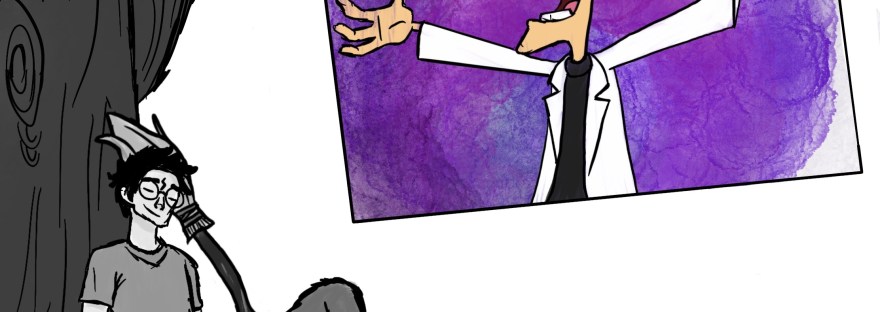
A child psychologist by the fantastic name of Bruno Bettelheim looks at the composition of characters in fairytales and children’s stories. He finds that in an effort to teach kids what is good and what is bad, these mediums create a harsh divide between ‘good’ and ‘bad’, often creating characters that embody all good traits, and others who embody all bad (e.g. A princess is generous, trusting, helpful, while a wicked stepmother is greedy, unkind, etc.). An unfortunate amount of boring skinny white heroes and big wrinkled villains are born from this technique. Moreover, it’s not real, there’s nothing in reality that is entirely good or entirely bad, which is exactly what we want to keep in mind when staging A Streetcar Named Desire.
Tennessee Williams is one step ahead; he writes in thoroughly detailed realism, having each action layered on others to try and create a convincing effect. But it’s easy to get caught up in every minute detail. What’s most important is that we have Dr Doofenshmirtz and not Harry Potter.
Harry Potter is a perfect character; he’s the embodiment of brave, he’s famous but bullied enough to be sympathetic, he befriends the underdog and is the star at his school sport. Harry Potter, somehow in a castle full of magic, is a boring dude. Dr. Doofenshmirtz is the antagonist of Phineas and Ferb, where he creates a plethora of inventions that don’t really end the world, but inconvenience the tri-state area. He befriends his enemies, looks after his daughter, and often times is the most likable character despite being the ‘villain’. Dr Doofensmirtz is flexible and fun. Even better, he’s interesting.
Good characters are three-dimensional. We should not know everything about them right away, nor should their protagonistic or antagonistic role define their personality. Cardboard characters will lead the audience to rolling their eyes as they experience an underwhelming sense of familiarity; a bland main character who embarks on a quest because it’s what’s right, a witty best friend who is content on making their entire life about the main character, a villain who just wants to see the world burn while they twirl their mustache. Characters must have reasons, a desire to fulfill and indecision in their actions.
As skillfully demonstrated by Marlo Brando, the characters of Streetcar must be complex and lifelike which, at first glance, may appear dangerously close to Stanislavski’s famous (or infamous) method acting. Richard Pells sums it up well in his book Modernist America: Art, Music, Movies, and the Globalization of American Culture.
“he [Stanislavski] wanted his students not just to recite their lines or impersonate a character but to genuinely see, think, and react – in short, to create a fully realized human being on the stage.” (Pells, 345)
While wonderfully ambitious, this method may go a step too far, seeing as there is a difference between creating a complex character for a performance, and letting a whole new human being embody what used to be an actor. Stanislavski condemns the use of wild acting, but it’s premature: even a play like Streetcar might benefit from some insanity. Characters in fantasy with wings and magic powers can be real if the effort to make them balanced is there. Take a look at Yuri Bustov’s production of The Seagull, with screaming and comically absurd staging and acting decisions staining the realistic play yet somehow managing to clearly convey the meaning of each line. The importance here is not how vehemently an actor performs, nor who (actor or character) gains the praise, but that the audience is able to see a character as a being with intention and life.
Stanislavski would like to go about making the characters on the page so real that they escape from the confines of ink and breathe as the actor breathes, he would like the actors to become possessed puppets. This is a dangerous direction to take. If I am acting as a patient in a simulation for nursing students to learn to deal with people suffering of mental illness, I must be careful to make sure the character is a different individual to myself. I should be able to enter a room, exhibit signs of schizophrenia and distrust, then exit the room myself, with ready smiles to the students and no extra shadows on my bedroom walls. There is an inclination to take method acting to the point where the character invades the actor’s own self, losing weight, twisting thoughts, affecting behaviors outside of a dramatic space. It is enough to step into a character’s shoes, you don’t have to wrap yourself up in their skin. Theater is for us, for people. It doesn’t make sense to compromise ourselves in its pursuit.
A good idea in finding a balance between cardboard and flesh is to look at character, look to which side (good or evil) they lean and inspect all that makes them the opposite. Find heroes’ mistakes and selfish moments, find villains’ tender hopes. It may first be difficult to view Stanley as anything else than a buffoon, but in seeking out his moments of vulnerability, we reach a better understanding of the play. He is not just a pair of fists, loud voice and overall menace, he cares about Stella, he feels insecure around Blanche’s gaze, both of those should influence how an actor goes about him. David Ball makes one of his insistent suggestions on the matter:
“Yet people direct Hamlet or write books about it without ever considering at what point the audience discovers that Claudius is guilty. So the actor playing Claudius portrays him obviously guilty right from the start. The cat’s out of the bag, the audience cheated by knowing too soon.” (Ball, 32)
Stanley should not be played as an abusive man from the very beginning, nor the majority of the piece. Blanche should definitely not be played as mentally unstable on her introduction. These are little secrets that the actors get to help the smooth progression into what the characters may reveal about themselves, but if they really know their characters, they will know that Blanche will show none of that without pressure, nor will Stanley get physically violent without a few drinks in him or one comment too many injuring his pride. Certainly, Stella cannot be played as an ignorant housewife who will return to Stanley with endless forgiveness for obvious infractions; she knows what many don’t, she knows her husband closely and cares for him as he does for her, even if they clash and disagree. She is in a place and time where she doesn’t have the power to make everything work out her way. She must be played with heart and clever understanding.
Why though? Would the opposite of this proposal be so bad? Countless stories rely on cookie-cutter characters because they work. They entertain, and if Brecht is to be believed, shouldn’t that be the point? I’d say that if you want pointless entertainment, glance out the window and watch a grey squirrel leap out of a trashcan straight into the road without a shadow of fear (they’re freaky). Theater is a bit beyond that. We don’t just want to make a few minutes of laughter and engagement that will be forgotten before their heads reach their pillows. After watching a production of The Nether by Jennifer Haley (about sixteen times as I was on crew), it was clear that the play was unsettling; a man is being interrogated about a virtual reality he has created to engage in simulated pedophilia. Yet the most chilling part was that at the end you’re left with an unprecedented thought: …the pedophile has a point. Papa, our devious mastermind, is often loud and rude and threatening, but it’s because the place he has created where he can safely carry out his desires and be happy without actually hurting anyone is being taken away. He’s scared and frustrated. He’s horrible but he’s smart and persuasive. That feeling, exiting the theater with a chill down my spine and the fact that I think of it still months later… isn’t that good theater?
In A Streetcar Named Desire we must ask our actors to sit down and understand their characters, their motivations, get to know them like a close friend, then mimic those behaviors. Sure, the play can be put together in a variety of ways and still make some sense so long as it hits recognizable plot points. But a Power Point can do that. Considering that much of these characters were drawn from Tennessee Williams’ own life, and that our understanding of them, our affection or investment, could go from dramatic fascination to a drastically diminished: wow everyone in this play sucks.
Work Cited
- “A Method They Couldn’t Refuse.” Modernist America: Art, Music, Movies, and the Globalization of American Culture, by RICHARD PELLS, Yale University Press, New Haven; London, 2011, pp. 343–372. JSTOR, http://www.jstor.org/stable/j.ctt1npnb3.15. Accessed 13 Feb. 2020.
- A Streetcar Named Desire. Dir. Elia Kazan. Warner Bros, 1951.
- Ball, David. Backwards and Forwards: a Technical Manual for Reading Plays. Southern Illinois University Press, 2017.
- Povenmire, Dan, and Jeff Marsh. Phineas and Ferb. Season 1-4, episode 1-222, 2007.
- Haley, Jennifer.The Nether. Samuel French, 2015.
- Williams, Tennessee, and Elliott Martin. Browne.A Streetcar Named Desire. Penguin, 2009.
- Bettelheim, Bruno. “Transformations: The Fantasy of the Wicked Stepmother.” Folk Groups and Folklore Genres: a Reader, Utah State University Press, 1990, pp. 178–184.

 Sabrina Parra Díaz